


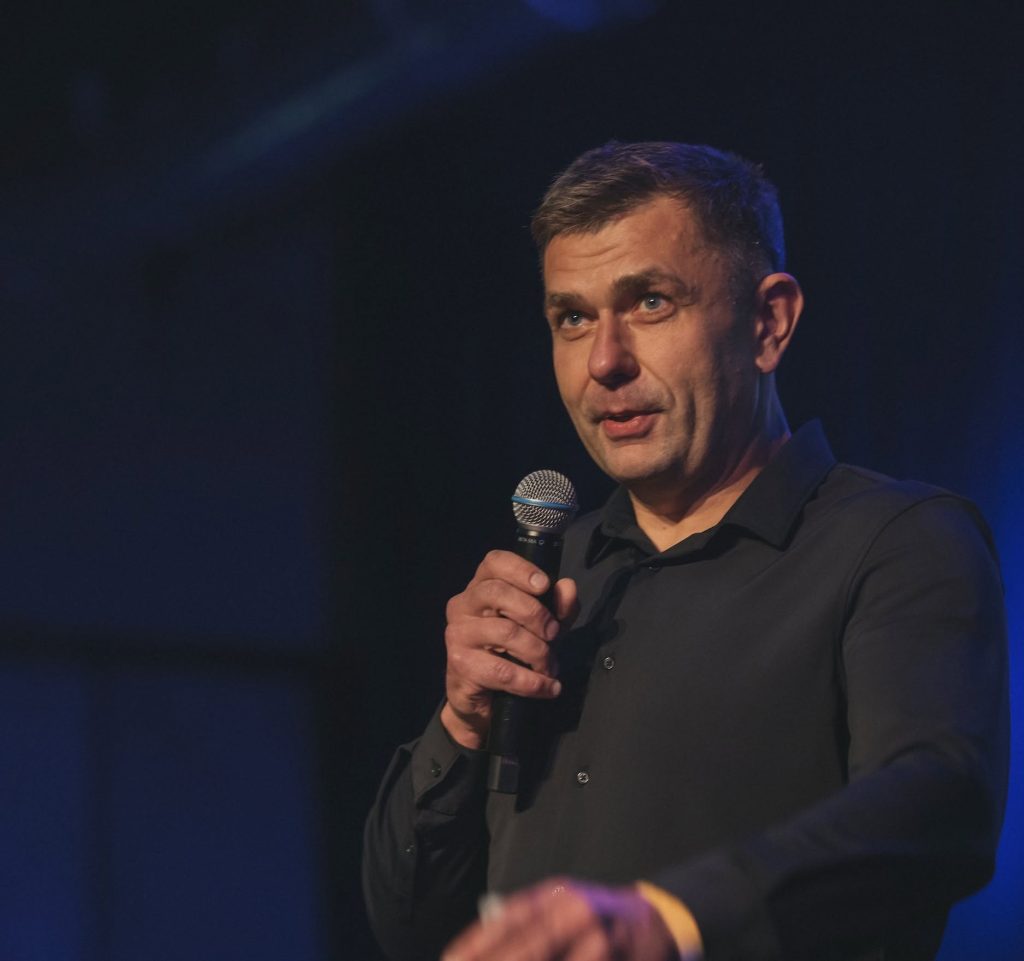
Watching global technology trends and analysing market changes, one thing becomes obvious: the speed of decision-making in business is critical, but it cannot be increased at the expense of security and compliance requirements. Last week, at the AI in Financial Services conference in London, we shared insights on exactly this balance with leaders from the financial sector. Discussing best market practices together with experts from Moterra AI, a clear trend emerged: full control over artificial intelligence (AI) tools and guaranteed data security are becoming a core priority for modern businesses.
We are not the only ones who can see where infrastructure standards are heading, but long-term observation of the processes shows a clear direction: AI adoption is no longer just a choice – it is a condition for business survival. Organisations that do not start integrating these solutions into their operations today will most likely have nothing left to optimise in five years’ time – they will simply be pushed out by competitors who adapted faster.
Why AI adoption is a unique chance for Lithuania
Despite the challenges, this technological era opens up vast opportunities for Lithuania and its companies. Historically, national success stories – such as Singapore, South Korea or Ireland – needed not only an idea and a convenient geographical location, but also enormous capital. Today’s AI technologies fundamentally change the rules: to build a global product, a good idea, knowledge and minimal investment are enough.
This does not mean that capital no longer matters. But technology drastically lowers the barriers – now what matters most on the way from idea to execution is persistence and consistent work. For our country, curious by nature and quick to embrace innovation, this is a unique chance.
We are now at a crossroads. We can remain among those markets where public and private sector processes are still stuck in the past (for example, even today some of our clients in Germany still communicate officially with local authorities by fax). There is a big risk of becoming dependent on illogical EU projects and grants which, instead of boosting competitiveness, often just give bureaucrats and related structures an opportunity to profit. Such a passive, subsidy-dependent path is ruinous for a small country. Large economies can afford to experiment with various benefits or socialist models, while we have no time – we must act fast to become an example of innovation for others.
AI gigafactories or AI skills?
In public debate, one often hears that we should rely on the “AI gigafactories” being created by the EU, hoping that large corporations will build independent AI infrastructure for us. But here we face a fundamental problem: AI is not traditional construction. Having instructions and simply investing massively in project scale in no way guarantees that a project will succeed. The reality is that this infrastructure skeleton and billions in EU grants may simply settle in the reports of successful corporations without delivering any tangible result.
Lithuania’s path should by no means be investment in infrastructure or hardware alone – that is the playground of big countries. We all understand it is not for us. Our formula for success lies in education and the everyday application of technology. We need to create an environment in which everyone, at work and at home, can use AI tools effectively. The younger generation hardly needs to learn this, but we must say clearly to the business community: by rejecting these tools, you risk simply disappearing from the market of the future.
The state can contribute – not by building hardware, but by funding AI education and the use of specialised tools. We must create global products by investing in ideas that truly shape the future.
As Confucius aptly observed back in the 5th century BC: “In a country well governed, poverty is something to be ashamed of. In a country badly governed, wealth is something to be ashamed of.”
Purposeful use of technology opens up the opportunity not only to adapt smoothly to market change, but also to become an example for others, building an even stronger Lithuania together.
—
Skaylink is a Vodafone Group IT services company that has been providing IT services to businesses in Lithuania for 20 years. Our business portfolio covers IT infrastructure maintenance and management, workstation support, IT outsourcing, cybersecurity services (SOC, penetration testing, external attack surface management / EASM), cloud solutions (AWS, Azure), data security, business continuity and AI training. Learn more about our IT services or contact sales@skaylink.lt.
