


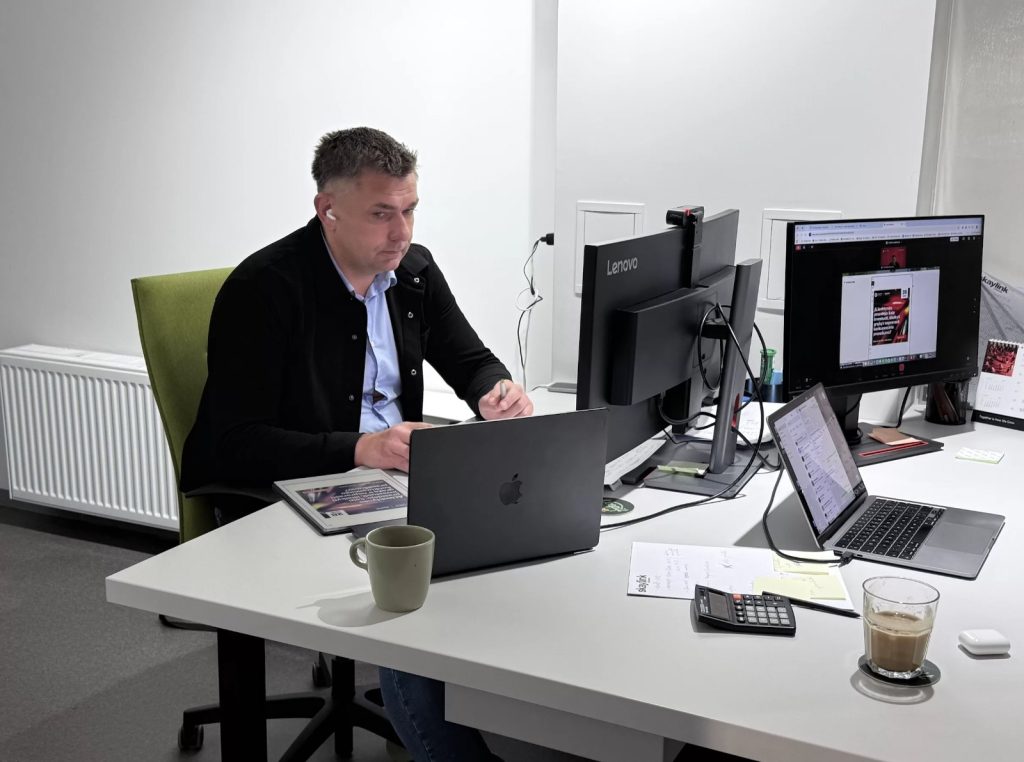
“Every executive I talk to today has the same question,” says Donatas Zaveckas, Head of Skaylink Lithuania. Not “should we use artificial intelligence (AI)?”, but “how do we implement it without making costly mistakes?”. Proven best practices are still scarce, so Skaylink first rolled out AI within its own team, and only then offered it to clients. Zaveckas shared this experience at the 28 October webinar “The AI race has begun: how to invest, sustain ROI and keep your competitive edge”. “AI will not replace people. It will take a large share of routine work off their hands and free up time for what matters most – growing the business,” says Zaveckas.
What AI costs and what it delivers
For a mid-sized organisation of around 100 people, the cost of AI today is comparable to the salary of one or two employees. The gains in productivity, speed and quality of work, Zaveckas says, are incomparable. He highlights three things AI unlocks:
- Capital. Optimising processes no longer requires large budgets for prototypes and testing. A lot can be done with very little money.
- Talent. Gifted employees who think differently can be handed the flag and given the chance to become leaders.
- Time. Work that used to be planned for six months is now done in two weeks. The difference between working with AI and without it is often not twofold, but tenfold.
4 lessons from Skaylink’s own AI rollout
Skaylink rolled out AI across the whole company not for a nice story, but to see where it breaks. Every week, managers meet to share which solutions they have implemented in their teams and where they need help. Four lessons came out of this experience:
- Technology is the easy part. Security approvals, data access and permissions take longer than the implementation itself.
- People don’t adopt “AI” – they adopt one task that got faster. Start with 2–3 specific processes rather than announcing AI to the entire company.
- Trust is the biggest brake. Teams use AI properly only when they know where their data goes. Skaylink’s data stays in its own cloud environment.
- Measure usage and results, not licences. A report showing who uses AI, for what and how much time it saves changed the conversation with management.
“You can’t force a horse to drink. Expensive licences bought just to tick a box for the board deliver nothing. You need to pick the projects, calculate the return and show the results,” says Zaveckas. According to him, Skaylink’s team in Vilnius is today ahead of a number of its Western European colleagues in the group in this area.
For regulated businesses, what matters most is where the data lives
Most companies started using AI spontaneously: employees pick ChatGPT, Claude or other tools themselves. That works for internal tasks. But once customer data, contracts or financial information go into AI, regulation applies. “If you have to comply with GDPR, DORA or NIS2, today we see no other way: Claude via AWS with Moterra and Skaylink. Azure is also possible, but with nuances,” says Zaveckas. A webinar participant asked: can Claude Team plans be combined with Claude via AWS Bedrock? Yes, and for many companies it is the smartest path:
- Claude Team plans – for everyday internal work that involves no customer or sensitive data.
- Claude via AWS Bedrock in European data centres – when GDPR and other regulatory compliance is required. The data stays in Europe.
To make AI convenient to use in an AWS environment, Skaylink partners with Moterra. The platform lets you manage AI the same way the IT department manages other systems: permissions and groups from Active Directory, user limits and cost control, integrations with internal systems, and a fully isolated environment. “It is the gateway between your AI and the outside world. Employees get convenient tools, and the executive sleeps soundly because they know where customer data goes,” says Zaveckas.
Where to start
Zaveckas’s advice is simple: choose 2–3 processes with the most routine work, calculate the return and start a controlled experiment. Nobody knows exactly what things will look like in six months, but the winners will be those who turn AI into an everyday tool rather than just a word in presentations.
AI transformation: from 5 problems to AI your team uses every day
What Skaylink tested within its own team, it now offers clients as an AI transformation service. The work starts not with technology, but with the question of where your company actually loses the most time. Together with department heads, the Skaylink team maps how work is done today and selects 5 problems worth solving first: for example, customer service answering the same questions every day, the sales team writing emails and meeting summaries by hand, or finance checking invoices against orders manually. For each problem, the cost of the solution and the return are calculated, so management can decide based on numbers rather than enthusiasm. AI projects have become far more accessible. Only a few years ago, a similar change cost from €10,000, often more than €100,000, and results took a year to arrive. Today an AI project starts from €1,000, and the first working result is delivered within a few weeks. Each stage – opportunity assessment, proof of concept (PoC), and a pilot integrated with your CRM, ERP or Service Desk – can be ordered separately, deciding after each one whether to continue. Before the PoC, we agree on one measurable goal; if it is not achieved, the PoC fee is credited towards the next stage. The solution is chosen based on the data it will handle. When data must stay within the company, AI is built on the private Moterra platform; in other cases Claude, ChatGPT Enterprise or Microsoft Copilot are used. A key user is trained in every team, and a Skaylink engineer works alongside your team until the solution is running in production. After launch, AI is maintained like any other IT system: with an agreed response time (SLA), monitoring and reporting, and every new problem becomes the next project. Not every company is ready for a project straight away. For them, Skaylink suggests starting with team training – from prompt writing to AI training for executives. You can calculate how much routine costs your company today and how much time and money AI would free up in the calculator on the AI transformation page. Talk to an expert: we will discuss which of your tasks are a fit for AI, how to align Claude plans with regulation and where to start. Email sales@skaylink.lt or call +370 5 203 4385. Skaylink Lithuania is part of Skaylink, a Vodafone Group company. 100+ specialists in Lithuania and 550+ cloud and security experts across Europe help organisations move to the cloud securely, manage IT and protect themselves against cyber threats.
