


Workstations are powerful computers designed for specialised software. They are most commonly used by architects, 3D and video editing professionals and graphic designers. A typical user of AutoCAD, Blender, Revit or SolidWorks will know workstations well.
The Lenovo ThinkStation P620 is among the most sought-after workstations in the industry, and this review explains why.
The first workstation with AMD Threadripper Pro
It is the first workstation with AMD’s Threadripper Pro – at the time of writing simply the fastest CPU on the market, with a lead measured in multiples rather than percentages. It has up to 64 cores, PCIe 4.0, ECC memory and the security, management and other capabilities of server CPUs enabled. You no longer need a Xeon or an EPYC if you require over 1 TB of memory or 128 PCIe lanes. The Threadripper Pro is only available in OEM workstations, and currently only one is on the market – the Lenovo ThinkStation P620.
For the review, Lenovo provided a ThinkStation P620 with a 12-core AMD Threadripper Pro 3945WX CPU, an Nvidia Quadro RTX 4000 graphics card, 32 GB of DDR4-3200 ECC memory and a 512 GB NVMe SSD.
Cooling, ECC memory and storage
Inside the P620, the Threadripper Pro sits under a massive heatsink with two fans working in push-pull mode. They move the heat towards the case fan at the back, which pushes it out of the case. All 8 DDR4 memory slots are also actively cooled. Filling them with 64 GB modules gives a total system memory of 512 GB.
The DDR4-3200 ECC memory used in the P620 is most commonly found in servers. ECC (Error Correcting Code) memory stores additional parity information, which makes it possible to detect and correct single-bit memory errors, usually caused by external environmental factors. In other words, it minimises the chance of your application crashing, giving you confidence that the render you left running overnight will produce what you expected, rather than an error message on your screen.
Under a small heatsink, the motherboard has two M.2 slots for NVMe SSDs. The P620 fully supports Gen4 NVMe drives, with sequential speeds of over 6 GB/s. Besides the M.2 slots, the P620 also has two easily accessible bays for 3.5″ or 2.5″ storage devices.
Cable management is exceptionally tidy. The power supply is fully modular, and a premium 1000 W 80 Plus Platinum unit comes as standard in the P620. This means it reaches at least 94% efficiency under optimal load, so only about 6% of electrical power is wasted.
Ports, connectivity and GPU options
At the back, the Lenovo P620 has the usual 3.5 mm microphone, line-out and line-in jacks. It even has PS/2 ports for older keyboards and mice, two USB 2.0 Type-A and four USB 3.2 Type-A ports. The rear panel is completed by an RJ-45 Ethernet port capable of 10 Gb speeds – old news in servers, but still quite rare in PCs.
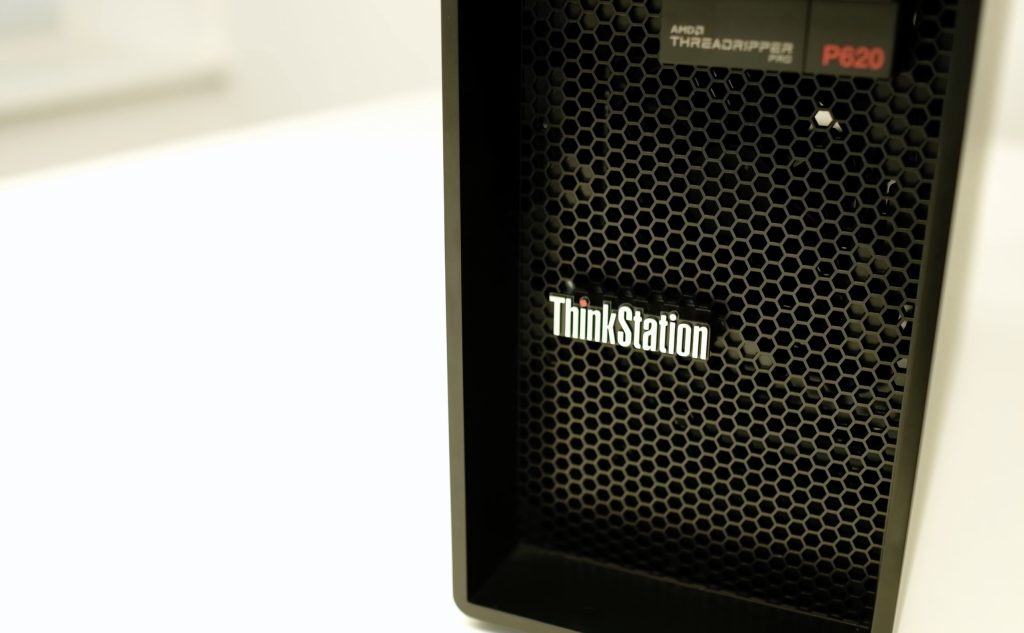
The front of the P620 case, with its honeycomb grille and a fan behind it, is optimised for airflow. Besides the DVD-RW drive and card reader combo, the front also offers two USB Type-A and two USB Type-C ports, a headphone + microphone jack and a 4-segment diagnostic display.
Finally, the P620 supports up to two of Nvidia’s latest RTX A6000 48 GB Ampere-based graphics cards, or four Quadro RTX 4000.
Looking inside the P620, you can’t help feeling you are looking inside a server rather than a PC. Modular design, efficient use of space, meticulously designed cooling – everything in one package. The review is brought to you by Lenovo and BTT Cloud (now Skaylink) – the only Lithuanian reseller with the Lenovo Workstation Expert certification and the leading partner in SMB business-class sales across the Baltics. Find out more about Lenovo for business.
