


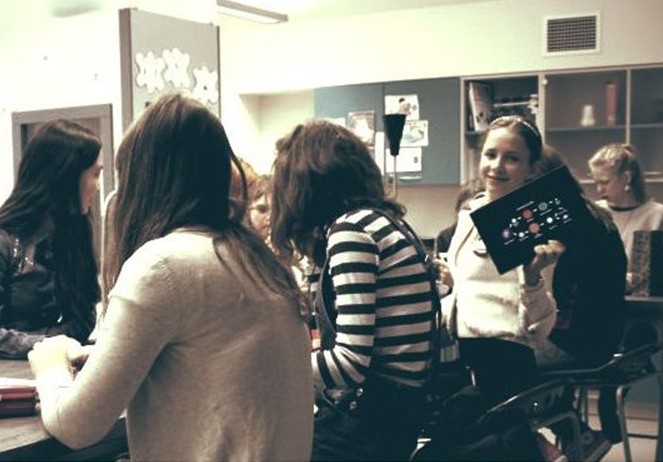
New technologies and smart devices found their way into Lithuanian schools long ago. But is investing in a new computer lab and an interactive whiteboard really what a modern school needs? Or rather, is it enough? How do you choose, from the many products and solutions on the market, the ones that will best serve their main purpose – helping teachers and pupils in the learning process?
The IT innovations that greeted pupils and staff of Vilnius International School (VIS) after the summer holidays this year would probably not surprise pupils or teachers at other schools keeping pace with modern technology, but they would certainly interest anyone who follows the latest tech. And, of course, they would hold plenty of surprises for those who still associate lessons with a chalky blackboard and cardboard posters on classroom walls.
Technology choices driven by the school’s educational principles
The school follows the International Baccalaureate programme, whose core values are inquiry-based learning, integrated skills development and international-mindedness. All of this was taken into account when choosing IT equipment for the school, both for pupils’ learning and for staff convenience.
“It’s not particularly hard to buy a lot of new computer equipment, but is that the main goal?” asks VIS technology teacher Antanas Stonkus. In his view, it is far more important to choose teaching tools that help achieve the goals of the learning process – not tools that leave teachers puzzling over how to adapt the curriculum to make use of the equipment. Technology should not become the central axis around which curricula are built. The main role of new technology is a supporting one.
For this reason, when the school launched its Technology project to purchase audiovisual and computer equipment, it set up a Technology Committee. The committee included, first and foremost, the teachers who used technology most actively in their lessons, as well as IT specialists from BTT Group (now Skaylink Lithuania), the company providing the school’s IT support services.
The committee began with a thorough study of how the school’s existing computer and other technical equipment had been used. As a result, it decided to drop traditional fixed interactive whiteboards in favour of mobile solutions, bought tablets and laptops, and implemented other solutions based on practical observations and innovation.
Learning maths online
While many parents and teachers are wringing their hands over how to get children away from computers and the internet, VIS maths teacher Tony hands out tablets to the eighth-graders filing into his classroom. Waiting for them are practical maths exercises available online on the learning portal KhanAcademy.org.
“The children really like the portal’s format, the presentation, the challenge and the fact that they can clearly see their progress,” says Tony, showing charts of pupils’ achievements on his computer. “Thanks to this programme, I can see which pupils are doing well and can take on extra or revision tasks, and who needs to try harder or spend more time on the topic.” Pupils who did not understand a lesson can watch the video material on the portal on their own, as many times as they like and whenever suits them – at school or at home.
Since many pupils bring their own computers or smart devices to class, the school’s management decided to buy fewer laptops and tablets but with better specifications – for pupils who don’t have their own, have left theirs at home, or whose device’s operating system doesn’t support the apps used in the lesson.
Visual materials come first
Although most teachers at the school use audiovisual tools to display materials on the board, only a few VIS teachers enrich their lessons with the advantages of interactive whiteboards. So the school dropped the idea of equipping a room with a fixed interactive whiteboard and opted for a solution almost half the price – a mobile interactive whiteboard system. Teachers can easily take it to any classroom that has a magnetic board and a projector.
This innovative solution proposed by BTT Group specialists not only provided mobility but also freed up more budget for higher-quality projectors. One of the main requirements for the projectors was long-life (LED) light-source technology, which reduces running costs. The main drawback of traditional lamp-based projectors is their relatively high running costs, caused by the limited lifespan of the lamps.
Another innovation warmly welcomed by pupils was WiDi (Wireless Display) technology, installed in the design technology classroom. Pupils who complete tasks on laptops or tablets can show their work to others in real time on the monitors installed in the classroom.
Pupils’ online safety is the top priority
As part of these plans, a wireless network accessible to all pupils and staff was installed across the whole school site (not just in selected areas). This was unavoidable: under the International Baccalaureate programme, school work is structured not in traditional lessons but around joint pupil projects, and learning happens constantly and everywhere – even in shared spaces, the lobby and the schoolyard.
However, this decision did not come without discussions about digital security – one of the biggest challenges at a school where more than 200 users connect to the internet every day from a variety of devices.
“With the Cyberoam (now part of Sophos) network security equipment we proposed, we restricted access to certain websites – above all social networks and sites that are harmful to pupils,” said BTT Group specialist Donatas Ratinskas, adding that users browsing on the internal network are also protected against virus attacks. In addition, this manufacturer’s devices also ensure data privacy. After all, all documents and learning tools (homework, attendance registers, the grading system, shared applications, etc.) are stored in the school’s system in the cloud and can be accessed securely from any device, both at school and beyond.
Learn more about our IT services and security and compliance solutions.
