


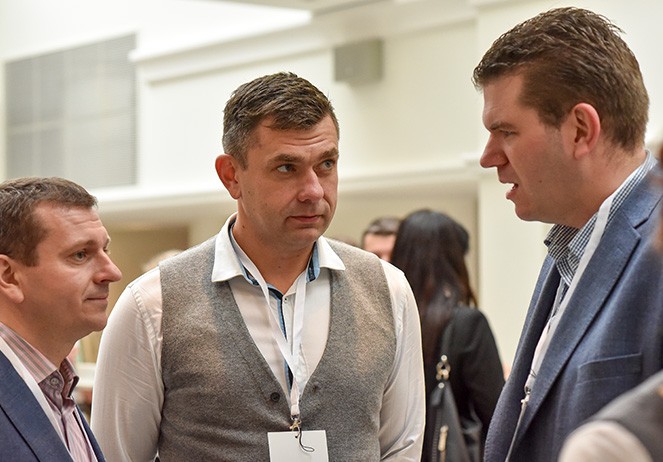
Simon Besteman, director of ISPConnect, the Dutch association of internet service providers and communications technology companies, who attended the International IT Projects & Trade Conference hosted by BTT Group (now Skaylink Lithuania), gave an interview to Verslo Žinios (Lithuania’s leading business daily). Simon talked about cooperation between the Netherlands and Lithuania and presented a joint Dutch-Lithuanian project (BTT Group and DigiState) – the LoRa network.
The Dutch are rolling out an Internet of Things network in Vilnius with BTT Group (Verslo Žinios article, 14 November 2016)
Dutch companies are interested in investment and cooperation opportunities in Lithuania, says Simon Besteman, director of ISPConnect, who recently visited Lithuania.
“Of course Dutch companies are interested in opportunities in Lithuania. That’s why I’m here. I have already spoken to representatives of Invest Lithuania and Infobalt, the Dutch Ambassador to Lithuania and others. One joint Dutch-Lithuanian project is already under way in Vilnius – DigiState together with UAB BTT Group is building a LoRa network in Vilnius. But we are looking for more opportunities to cooperate,” says Mr Besteman.
The two companies are setting up a joint venture in Lithuania that will deploy and expand the so-called LoRa network for the Internet of Things in Vilnius. The network is planned to go live in Vilnius next April.
LoRa is a long-range, low-data-rate (0.3 kbps to 50 kbps) wireless network operating in the sub-1 GHz frequency band, which requires extremely low energy consumption from the devices connected to it.
Such a network is said to be especially important for connecting various Internet of Things objects, as many of them could not connect to an ordinary home or office Wi-Fi network.
The LoRa network is already working
“A large share of Internet of Things objects – all kinds of sensors, cameras and so on – could in principle be connected to an ordinary mobile network. But you would most likely have to coordinate frequencies and communication channels. It would also require a lot of energy. So that solution does not suit sensors and other small devices, which usually run on batteries. LoRa is designed to need extremely little energy, so many ordinary sensors with standard batteries can run continuously for up to 10 years without a battery change,” explains Donatas Zaveckas, CEO of UAB BTT Group.
The Netherlands was the first country in the world to launch a LoRa network nationwide. Last year it went live in Rotterdam (the country’s largest port city) and The Hague, and since July this year it has covered the whole country.
“In Rotterdam, refuse trucks only go to empty containers when they are full – and the containers report this to the companies themselves. Perhaps one day it will be like that in Lithuania too,” says the BTT CEO, vividly illustrating the benefits of a LoRa network.
“The Dutch contributed their knowledge and software to this joint project – software is probably one of the most expensive elements of the project – while we work as sellers and integrators: we look for potential end users of such a network, assess where best to put up the transmission towers, and so on,” Mr Zaveckas continues.
The data business
Mr Besteman, who took part in the IT projects and trade conference organised by BTT Group in Vilnius, has not yet gone into detail about what kind of cooperation he has in mind.
However, it will most likely involve activities related to cloud computing and data transmission, processing or storage, as these are the most important business areas for ISPConnect members.
Mr Besteman also emphasised these areas in his conversation with VŽ. According to him, there are about 1,500 hosting and other internet service providers in the Netherlands, although only about 250–300 of them have more than 50 employees. Amsterdam and its suburbs alone have 200 data centres.
The Dutch information and communications technology (ICT) sector employs about 140,000 people. Its annual turnover is about €10 billion and grows by about 10 % a year. According to Infobalt, the Lithuanian ICT industry association, the Lithuanian ICT sector is growing at a similar pace, but its revenue is only €1.5 billion (the turnover the sector’s companies reached last year).
The Dutch may also be interested in joint projects with Lithuanian companies, or in buying support and maintenance services from Lithuania, as specialists’ services here cost roughly half as much as in the Netherlands.
A big salary gap: why Dutch companies look to Lithuania
The average salary of a network engineer in the Netherlands is about €40,000–45,000 a year (in Lithuania, about €24,000 a year). A senior network engineer in the Netherlands earns €70,000–80,000 a year, a Java developer about €35,000–40,000 a year, and a senior Java developer about €80,000 a year.
The market sometimes suggests that Dutch businesses see Lithuania as a gateway to Russia and other Eastern countries. Mr Besteman firmly denies this. If Lithuania is to be seen as a gateway, he says, it is certainly not to Russia, but to the Scandinavian countries.
“Lithuania has good infrastructure, a stable geopolitical situation and good specialists, while prices here are much lower than in our country and in many others. And I really like the way the government and organisations such as Invest Lithuania welcome potential investors,” says the head of ISPConnect.
